
Every year, more or less around the same time, the same thing always happens… we stop for a moment, look back and try to make an end-of-year assessment 😅
The problem is not doing it but it is as You do. If your year-end report always ends with sentences like:
“I spent too much”,
“I couldn't put anything away,”,
“next year I will work more”,
Then you're probably just piling on guilt.
This attitude will lead you, the following year, to always find yourself in the same spot. Does that make sense to you?
📌 INDEX
1️⃣ Why the traditional year-end budget doesn't work
2️⃣ Because every year is the same as the previous one
3️⃣ The most common beliefs that keep you stuck in the hamster wheel
4️⃣ The right questions to ask yourself at the end of the year
5️⃣ Concrete actions to prepare for change
✉️ Conclusion
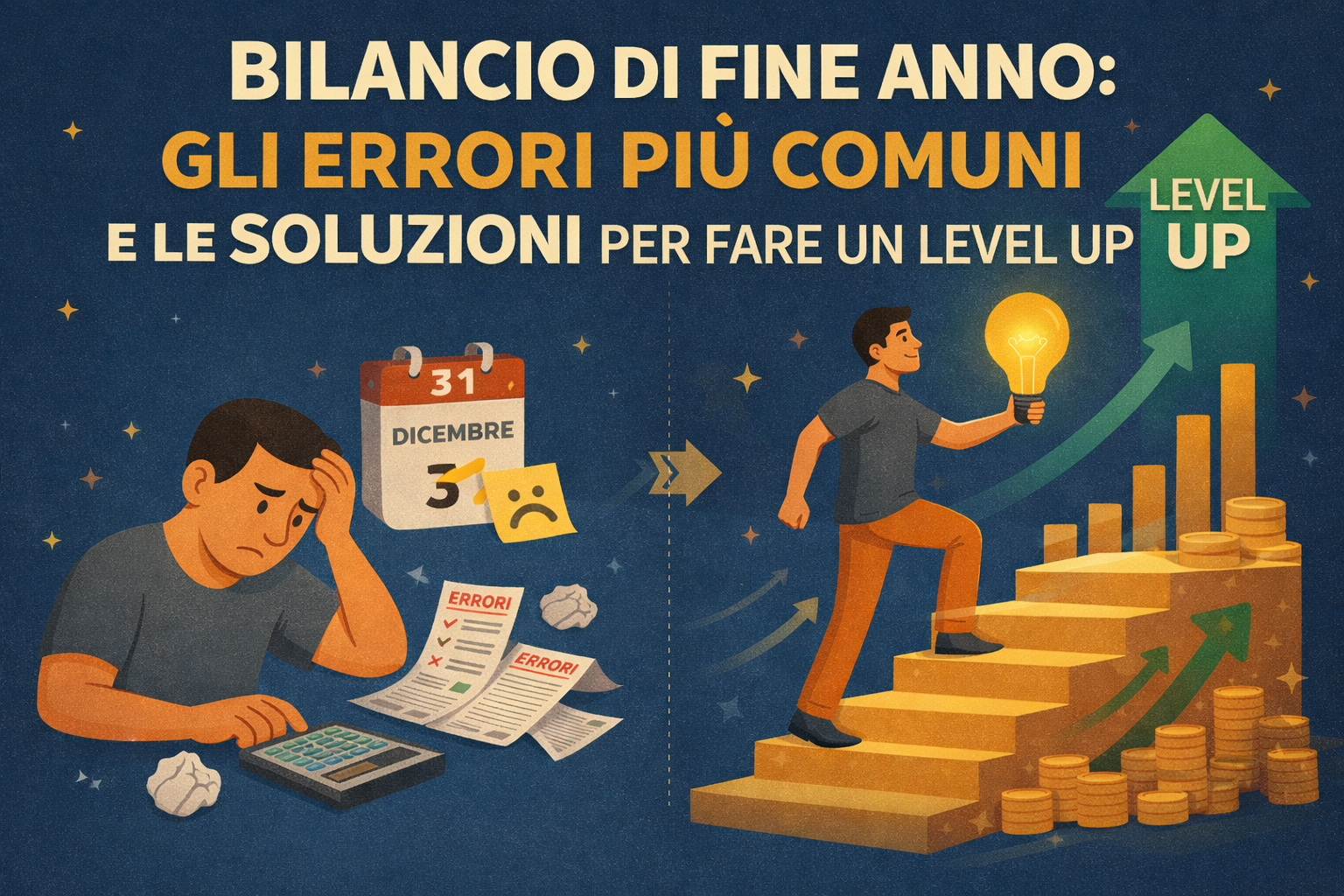
1️⃣ Why the traditional year-end budget doesn't work
Most people make their year-end assessments by looking at just two things: how much they earned and how much they spent.
It is a limited approach, because it photographs the past but it does not guide the future and it usually almost always generates two emotions:
frustration
sense of guilt
And when a person is frustrated or feels guilty, it is difficult to change strategy unless they become aware of it.
It is only promised to work harder.
The point is that thinking about working harder without first changing some dynamics isn't a great strategy.
It's a reaction... I suggest you also read this article: WORK LESS, LIVE BETTER: Here's the secret
A proper end-of-year review should help you understand if you're going in the right direction, not just whether you've been "good" or "bad."“
2️⃣ Because every year is the same as the previous one
At this point it is clear that the traditional end-of-year budget does not work.
But there is an even more important question to ask:
“Why, even though we realize it, do we continue to repeat the same patterns?”
The answer is not in the lack of will, but in the mental structure with which we face change.
Albert Einstein said:
“You can’t solve a problem with the same kind of thinking that created it.”
And that's exactly what we need to avoid doing 😎
The real mistake: looking to the future with the head of the past
When you take stock at the end of the year, your brain tends to do one very specific thing:
USA the same categories, the same beliefs and the same fears of the year that just ended.
In practice:
you analyze the future with old tools
you are looking for new results with identical habits
you want a change without changing your point of view
It's like trying to go left by turning the steering wheel to the right... it's not easy, right? 😂
The end-of-year budget as a ritual (not as a tool)
For many people, the year-end review has become an emotional ritual, not a strategic tool.
A moment when:
the "mistakes" committed are listed
generic promises are made
hopefully "this time it will go better"“
But hope alone changes nothing.
As Seneca wrote:
“It is not because things are difficult that we do not dare, it is because we do not dare that they are difficult.”
If the end of year balance sheet doesn't bring you to dare to do something different, only a melancholic photograph remains.
The trap of invisible continuity
One of the reasons why every year is the same as the last is that change always feels big, demanding, and risky.
“He who leaves the old road for the new knows what he loses and does not know what he finds.”
So this happens:
references
you tell yourself “it's not the time”
stay in the known area
The problem is that the invisible continuity works against your evolution.
Day after day you make small choices consistent with the past, and at the end of the year you find yourself in the same scenario.
The end-of-year budget then becomes a confirmation, not a turning point.
Identity before actions
There is another key point that is often overlooked.
Before the actions there are the identity and that is, what you identify with. If inside you perceive yourself as:
someone who "works hard"“
someone who "isn't inclined"“
someone who "is content"“
Even the best year-end report will be interpreted in a limiting way.
As William James said:
“The greatest change in life is discovering that you can change your attitude.”
The end-of-year balance sheet doesn't tell you who you were.
It serves to choose who you want to become.
The true function of the year-end budget
A good year-end review shouldn't lead you to ask yourself:
“where did I go wrong?”
but:
“What patterns am I repeating?”
“What rules am I using without questioning them anymore?”
“What are my limiting habits?”
Only when you bring the year-end budget to this level does it stop being a sterile exercise and become a real turning point.
In the next chapter, we'll see what the concrete obstacles are that keep these patterns active, even in intelligent and motivated people 💪
3️⃣ The most common beliefs that keep you stuck in the hamster wheel
When you take stock at the end of the year and realize that, despite your efforts, you're still more or less at the same point, the solution isn't found in the outside world.
Everything you need is within you. beliefs with which you read reality and make decisions are crucial.
Beliefs are not occasional thoughts.
I am internal rules that guide your behavior automatically, often without you realizing it.
Until you become aware of this, everything that is sabotaging/limiting will continue to work against you.
“I have to work harder to deserve more”
It is one of the most widespread beliefs.
It leads you to think that any improvement must come from effort, continuous sacrifice, and “gritting your teeth”.
The result is that:
you work more and more
you have less and less energy
you never have time to stop and think
And without strategic thinking, the year-end balance sheet cannot change.
“I'm not good with money / finance isn't for me”
This belief is insidious because it seems humble, but in reality it is a form of renunciation.
You exclude yourself from:
financial education
conscious money management
building financial freedom
So you delegate everything: to the bank, to the consultant, to chance and every end of the year you play the spectator, not the protagonist.
“I'll take care of everything else first, then I'll think about myself.”
Family, work, responsibilities, there's always something more urgent than you.
This belief leads you to constantly procrastinate:
the study
personal growth
inner healing
the construction of alternatives
The end-of-year balance sheet, thus, becomes proof that "it's never the right time.".
“It's too late to change”
Another very common belief.
It tells you that you should have moved earlier, that it's late now, that the train has passed.
In reality this idea comes from your unconscious's attempt to protect yourself from the risk of change, but in reality, it is simply supported by a fear.
As long as you think it's too late, you remain still, and consequently every end-of-year report confirms the same story.
“If I do something different, I will disappoint someone.”
This belief is less visible, but very powerful.
It keeps you tied to the expectations of others: family, colleagues, environment.
As:
don't change your path
you don't explore alternatives
you don't step out of the role you've created for yourself
You pay the price inside, year after year.
The Way of Love: The True Way Out of the Wheel
This is where it comes in The Way of Love.
Not as an abstract philosophy, but as path of recognition and transmutation of beliefs.
The Way of Love starts from a simple premise:
You can't build freedom on the outside unless you first free what's holding you back on the inside.
In practice this means:
observe beliefs without judging them
recognize where they come from (fear, need for approval, insecurity)
transform them into new rules more aligned with your life
It's not about “thinking positive”, it's about take back responsibility for your inner world.
Do you want to understand more?
Join the dedicated Telegram group CLICKING HERE
Check out our YouTube channel CLICKING HERE
From year-end balance to inner truth
A true year-end review should not only lead you to ask:
“How much did I earn?”
but also:
“What beliefs guided my choices?”
“What fears have I let decide for me?”
“What parts of me have I put on hold?”
The Way of Love teaches you to look at these answers honestly, without guilt and without escape.
And that's where the end-of-year budget stops being a list of numbers and becomes an act of awareness.
In the next chapter we will see how to transform this awareness into new questions and concrete actions, capable of truly preparing the ground for a different year.
4️⃣ The right questions: from year-end assessments to the direction of your life
Once you've recognized the beliefs that keep you in the hamster wheel, the next step is only one:
change the questions.
This is the turning point of the year-end review, because as long as you keep repeating the same things to yourself, even with greater awareness, the answers will remain limited.
The new questions I'll list for you shortly, however, have the power to shift your perspective, your energy, and your actions.
The Path of Love starts right here:
not from judgment, but from honest observation of what you are creating in your life.
From “how much did I spend?” to “what am I building?”
The classic question in the end-of-year budget is almost always quantitative:
how much I earned, how much I spent, how much I have left.
These are legitimate questions, but incomplete, because they only measure the movement of money, not the direction of your life.
A more advanced question is:
“What have I built this year, even if it doesn't produce results yet?”
This includes:
new skills
healthy relationships
paths started
The Way of Love teaches you to recognize value even where the ego sees “not enough.”.
The most scary question (and that's why it works)
“How many people or situations do I depend on today?”
This question exposes an often uncomfortable truth.
Being totally dependent on a single income, a single role, or a single context creates fear.
And fear, as we have seen, fuels limiting beliefs.
In the end-of-year review, this question helps you to take responsibility for your actions, not to feel guilty.
Fewer dependencies means more inner freedom, even before financial freedom.
Time as an indicator of truth
Another fundamental question, often ignored, is:
“How many more free hours do I have than last year?”
Time is a very honest mirror.
If you work harder but live worse, something is wrong.
If you earn the same amount but have more mental space and time, you're going in the right direction.
The Way of Love pays close attention to this indicator because it is there that you feel whether your life is aligned with you or forced.
The Inner Questions (Simple but Powerful)
Alongside practical questions, the year-end review can also include simple but powerful internal questions:
“In what situations have I acted out of fear?”
“Where have I betrayed myself to please?”
“What have I been putting off so as not to disappoint someone?”
You don't need perfect answers.
It only serves honesty.
These questions aren't meant to make you feel guilty, but to free blocked energy, and that's exactly what The Way of Love proposes: recognize, welcome, transmute.
From year-end budgeting to conscious intention
When the year-end balance integrates both external and internal questions, something different happens.
You're no longer trying to “do better,” you're choosing how do you want to live more consciously?.
From this choice will arise the right actions, to create what is truly convenient for you.
In the next chapter we will see how to transform these questions into concrete actions, capable of truly preparing the ground for real change in the coming year.
5️⃣ Actions that truly pave the way for change
After having seen the beliefs that hold you back and the right questions to ask yourself in your year-end assessment, comes the most delicate point:
the actions.
Here many people get stuck, not because they don't know what to do, but because they are looking for the "right" action, the perfect one, the decisive one.
In reality, change does not come from heroic actions, but from consistent actions.
The Way of Love also shares this principle:
Don't force, don't run away, don't judge, learn to act in a way that is aligned with you.
From promises to daily micro-choices
One of the most common mistakes after the end-of-year review is to fill oneself with good intentions.
“Next year I'll do this, I'll fix that, I'll change everything.”
The problem is that promises don't change reality.
The daily choices, instead yes.
An action consistent with the you of this moment can also be “small”, but repeatable.
It's something you can do even when you're tired, even when you're scared.
And that's exactly why it works.
Building Financial Freedom Without Inner Violence
In the Freedom Project method, financial freedom isn't a race... it's a gradual build.
Concrete, but sustainable actions:
dedicate time to financial education, not just work
start a source of extra income, even a small one
invest only what you don't need to live
protect purchasing power
reduce expenses that don't give you real value
Try taking a look at these articles:
– FINANCIAL FREEDOM: Where to Start to Stop Counting Money
– SAFE EARNINGS ONLINE: Truth or Utopia?
– I WANT TO MAKE MONEY FAST: What You Absolutely Need to Know
– REAL ESTATE INVESTMENTS – Earn Money With Short Term Rentals
These actions have a huge impact over time, because they lower fear.
And when fear diminishes, limiting beliefs lose strength.
Less dependence, more inner space
Every action that reduces an addiction increases your freedom.
Dependence on:
one salary
a single role
a single context
sabotaging judgments
In the end-of-year budget, a good question is:
“What addiction can I reduce this year, even just a little?’
The answer doesn't have to be drastic, it has to be true and actionable for the you of today.
Time as an act of love towards yourself
An often overlooked action is to protect time.
We clearly cannot prevent time from moving forward,
but we can certainly choose how to invest it 😉
Even just:
30–60 minutes a day
without notifications
without noise
to study, reflect, breathe, clarify… without space, no change can hold.
Do you need help with this?
I wrote an article that might be very useful to you: The 3 x 15 Method: The Ladder to Changing Your Life in 45 Minutes a Day
External action and internal work must go hand in hand.
Here The Way of Love could help you make a difference.
If you act on the outside without working on the inside, you end up sabotaging yourself.
If you work inside without acting outside, you remain still.
Your year-end budget becomes powerful when you combine:
practical actions (finance, work, time)
inner work (beliefs, fears, identity)
It is in this balance that real and lasting change is born.
Prepare the ground, don't force the result
The real goal of stocks is not to “get everything right away”, but to prepare the ground.
A good year-end report doesn't say:
“I have to get there next year.”
He says:
“Next year I'll create the right conditions.”
And when conditions change, the results come by themselves.
✉️ Conclusion
The end-of-year review isn't a test to pass, it's not meant to judge you, nor to make you feel guilty for what you didn't do.
It helps you stop, take an honest look at where you're going, and recognize what beliefs have guided you, what questions you've continued to ask yourself, and what choices you've automatically made.
When the end-of-year balance becomes conscious, it stops being just about money, but also about freedom, time, dependencies, alignment.
The Way of Love reminds you that true change comes not from force, but from truth:
– Recognize what's blocking you
– Transform what you no longer need
– Act consistently, one step at a time
Today itself:
choose a belief to observe
ask a different question than usual
do a small but true action
Repeat tomorrow.
Choices change over time.
And when your choices change, the direction of your life changes too.
Thanks for being with me 🙏 Now try to build your next year, not as a repeat of the previous one…
but as a new conscious choice.
A big hug
David Bottero
Co-Founder of Progetto Libertà
 English
  Italian