



Reading time: 12 min
For years we have been made to believe that to create real estate income were needed:
hundreds of thousands of euros
20–30 year mortgages
a huge risk on your shoulders
And if you didn't have the capital, you were simply out of the game.
Today this is no longer the case.
The real estate market is changing, and with it, the options for access are changing too.
More and more people are starting to build real estate income with little capital, starting also from 1000€.
I know it may sound crazy but follow me.
I'll explain to you step by step how it's possible 😉
📌 INDEX
1️⃣ Why real estate income has always been reserved for a few
2️⃣ The Capital Problem: Mortgages, Banks, and Barriers to Entry
3️⃣ How the real estate sector is changing today
4️⃣ Real estate income without buying a house: the new model
5️⃣ How to Get Started with €1000 (Concrete Examples)
6️⃣ Where to Start: A Different Model of Real Estate Income
✉️ Conclusion
1️⃣ Why real estate income has always been reserved for a few
To understand why we are talking about it today affordable real estate income it's something new, we need to take a step back.
For decades, real estate has been a major pillar of wealth creation.
But not for everyone.
Historically, owning real estate meant having:
initial capital
access to credit
inside information
And these three elements have never been distributed equally.
🏛️ The traditional model: property = power
In the post-war period, especially in Europe and the United States, a very clear model emerged:
👉 those who own property build wealth
👉 those who don't have them work to pay for them
Banks become the main filter.
If you have:
stable income
guarantees
financial historian
Get credit… if you don't have it, you're out.
This has created a real barrier to entry over time, making the real estate income a privilege rather than an opportunity.
🏦 The role of banks and debt
The modern real estate system is based on a specific lever: debt 😅
A mortgage allows you to buy a property you couldn't afford right away... but at the same time, it ties you in for about 20–30 years.
This has two effects:
limit your freedom
select who can enter the market
Those who are not “bankable” are excluded and this clearly still holds true today.
🏢 The entry of large funds into the real estate market
Something even more interesting has happened in recent decades.
Large investment funds, companies and financial institutions have begun to enter the real estate sector en masse.
A well-known example is precisely that of BlackRock, together with other major operators such as Blackstone.
After the 2008 crisis, many of these individuals purchased huge amounts of real estate, especially in the United States, taking advantage of:
low prices
forced sales
market in difficulty
In some cases, entire neighborhoods have been purchased by institutional funds.
This led to two consequences:
👉 increase in real estate concentration
👉 progressive increase in prices and rents
📈 Rising prices and increasingly difficult access
When large amounts of capital enter the market, the result is almost always the same:
- competition increases
- prices are rising
- small investors have a harder time getting in
Those with large resources can move quickly, pay cash, and leverage the advantage of scale.
Those who start from scratch, however, often fall behind.
And this is where the great paradox arises:
👉 Real estate is one of the best sectors for generating income
👉 but for years it was also one of the most difficult to get into
🔒 The real problem: limited access, not lack of opportunity
The problem has never been a lack of opportunity.
The problem has always been access.
For years, the real estate market rewarded those with capital, knowledge, and structure, leaving everyone else out.
⚠️ Today something is changing
And this is precisely the key point of the article.
For the first time, thanks to new models, technologies and more accessible structures, the real estate market is starting to open up to those who:
he doesn't have large capital
he doesn't want to take out a mortgage
wants to create income more flexibly
It's not the norm yet.
But it's a clear direction.
And it is from here that the possibility of talking about it today arises real estate income starting from €1000.
2️⃣ The capital problem: mortgages, banks, and barriers to entry
Once you understand why the real estate income have always been reserved for a few, the more concrete question comes:
👉 “Okay, but where do I start?”
And here the real obstacle comes into play:
the capital.
Because the problem isn't understanding that real estate works.
The problem is getting into it.
💸 The classic starting point (that blocks everyone)
The traditional path is always the same:
find a property
go to the bank
ask for a mortgage
you hope they say yes to you
Simple on paper, a little less so in reality 😅
Because the bank, rightly, wants to know everything about you:
how much do you earn
what contract do you have?
What financial history do you have?
how “reliable” are you?”
Translated:
If you're not already in a good position… it's unlikely to help you improve it.
🏦 The banking paradox (that few notice)
There is an interesting paradox.
👉 To get credit you must prove that you don't need it 😂
If you have:
stable income
few expenses
clean history
they finance you.
But if you're just starting out, you want to grow, and you're looking for an opportunity… everything becomes much more complicated.
And so many people get stuck before they even start.
⛓️ The mortgage: opportunity or trap?
A mortgage is often described as the gateway to the world of real estate.
And it's true, but only in part.
Because along with the opportunity to start even without starting capital, it also brings:
long-term bonds (20–30 years)
exposure to risk
constant pressure
Basically, you're using your future to buy something today.
It's not necessarily wrong.
But without financial education, can turn into a real cage.
🧱 The invisible costs (the ones you discover later)
Many people think that the problem is only buying a house.
In reality, once inside, the “details” begin:
taxes
maintenance
rent-free periods
complicated tenants
unexpected expenses
And this is where many real estate investments stop seeming so simple.
Why create real estate income It doesn't just mean buying; it means knowing how to manage.
🧠 The mental block: "It's not for me"“
Beyond the technical obstacles, there is an even stronger one: the mental one.
Many people rule themselves out before they even try.
They think:
“it takes too much money”
“it's too complicated”
“it's not for me”
And in part they are right…
but only because they are looking at the old model.
🚧 The real problem is not capital
And this is where the key point comes in.
The problem is not just a lack of capital.
It is the lack of access to alternative models.
For years they showed us only one way:
👉 buy → rent → cash in
If you couldn't do it, you stayed out.
Today, however, different ways to enter the real estate sector are beginning to exist, even with much more accessible capital.
🧭 A different direction: the short-term rental model
In recent years, a new direction has opened up compared to the traditional model.
It's no longer just about buying a house and renting it long-term.
But to exploit properties more dynamically, especially through the world of short-term rentals.
This has also opened the door to operational strategies such as subletting, which allow you to enter the sector without purchasing properties, but with completely different logic and risks.
The central point is one:
👉 Income is no longer tied only to ownership
👉 but to the management
And this is precisely where the new way of building real estate income arises.
3️⃣ How the real estate sector is changing today
Until a few years ago, the real estate market followed fairly simple rules.
The old model was static:
- you buy a house
- long-term rentals
- earnings every month
Today this is no longer the case.
📈 The key transition: from static to dynamic
The real estate sector has become increasingly dynamic.
And one of the main drivers of this change has been the boom in short-term rentals.
Platforms like Airbnb have revolutionized the way to generate income from a property.
A property is no longer just a house to rent.
It has become a real productive asset.
🏙️ Short-term rentals: higher yields, more competition
Short-term rentals introduced a simple yet powerful concept:
👉 The same property can generate much more if managed differently.
This led to:
higher yields
greater rotation
new opportunities
But also to:
more competition
greater professionalization
entry of structured operators
And here something interesting happens.
🔓 The real change (that few see)
The key point is this:
👉 Real estate is no longer just about property
👉 has become management, strategy and access
Short-term rentals have opened a whole new door:
more flexible models
shared operations
access even with low capital
In other words:
the real estate income they are no longer tied exclusively to buying a house.
They are increasingly linked to the ability to understand the right model.
🧠 He who adapts wins
As in any market, those who remain tied to the old model have a harder time.
Who instead:
develops financial education
observe the changes
it fits
begin to see opportunities where others see only obstacles.
And that's exactly where we are today.
In the next chapter we will see how all this translates into practice.
4️⃣ Real estate income without buying a house: the new model
At this point you might be thinking:
👉 “Okay, the market has changed. But how do I actually get in?”
The turning point is this:
🧠 The paradigm shift: from ownership to management
Real estate income today is no longer tied solely to ownership.
It is increasingly linked to the ability to manage a property strategically.
With the explosion of short-term rentals, this concept has become evident.
The same property can be:
- unprofitable if poorly managed
- very profitable if managed well
And this is where a completely new scenario opens up.
🔓 Separate property and profit
In the traditional model, to earn money you had to own something.
Today, however, models are emerging in which:
he who owns does not manage
whoever manages does not own
those who invest participate without having to buy
This means that it is possible to enter the real estate sector even without:
take out a mortgage
immobilize large amounts of capital
take all the risk yourself
And here the game changes completely.
🏠 Subletting: a real opportunity, but be careful
One of the most concrete examples of this new approach is subletting.
In practice:
- rent a property
- you manage it in short-term rentals
- you earn from the difference
On paper it's simple.
And that's exactly why it attracts so many people.
But here we must be very clear:
👉 it's not a game
👉 and it's not a passive income
⚠️ What can go wrong
Many people get into subletting thinking it's easy.
Then they collide with reality:
- the owner does not accept short-term rentals
- the Municipality introduces restrictions
- the property remains empty for weeks
- costs exceed revenues
- damage or problems with guests occur
And in the meantime you still pay the rent.
📉 Realistic mini case
Imagine this situation.
You rent an apartment for €900 a month.
You put it on Airbnb convinced you'll earn €2,000.
The first few months are going well.
Then:
- the low season is coming
- bookings are decreasing
- expenses increase
Result:
👉 earnings €700–800
👉 but you pay €900 + costs
And you start to lose money.
This is the side that many don't tell.
🏗️ The new approach to real estate income
Today the real estate income can arise from multiple levers:
short-term rental management
participation in real estate transactions
shared models
already organized structures
In practice, you are no longer buying or sub-leasing “a property”.
You are entering a real estate system.
And this system can be much more accessible than in the past.
👉 Follow me closely because I'll soon explain how to actually get started, even starting with €1000.
5️⃣ How to get started with €1000 (concrete examples)
Let's get to the most important question:
👉 Is it really possible to generate real estate income with €1000?
The answer is:
It depends on how you decide to enter the market.
As we have seen in previous chapters, the real estate sector today is no longer just about ownership, but also about management and access models.
This means that there are different entry levels.
Each with completely different characteristics, risks and logic.
Let's see them clearly.
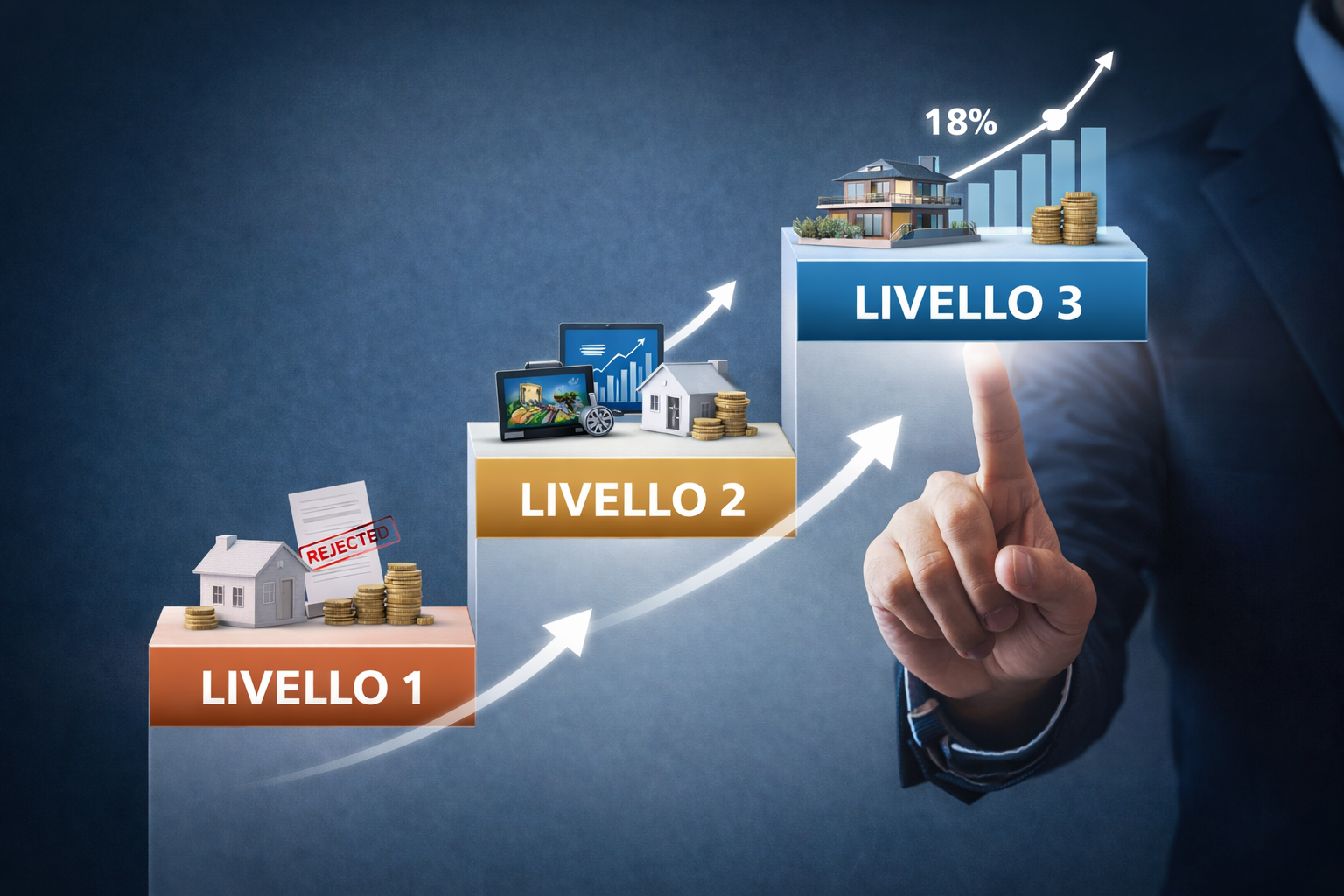
🔹 Level 1: Subleasing (quick access, but operational)
One of the most popular ways to enter the world of real estate income without buying a house it's the sublet.
As explained above, in practice:
you rent a property
you include it in short-term rentals
you earn from the difference
This model has grown a lot thanks to short-term rentals (we talked about it in Chapter 3).
It's accessible, fast, and attracts a lot of people.
But it is important to be clear:
👉 it's not a passive income
👉 it is a fully operational activity
🔹 Level 2: Participate in real estate transactions
A more advanced level is that of participation.
Here you do not directly manage the property.
You don't have day-to-day operations.
You join already structured projects and participate in the results.
This approach allows you to:
reduce operating time
avoid direct management
start building real estate income more steadily
But be careful:
👉 the point here is not “getting in”
👉 is choose carefully where to enter
Because, as in any market, not all opportunities are equal.
Without financial education (a topic we have already explored in depth), the risk is following enthusiasm rather than logic.
🔹 Level 3: Structured Systems
This is the level that represents the evolution of the real estate model.
It's no longer about improvising, trying things out, or chasing isolated opportunities.
It's about entering already organized systems, where:
- the model is tested
- the management is professional
- the risk is distributed
Here the perspective changes completely.
You are no longer looking for ways to make money from a single property.
You are building sustainable real estate income over time.
🎯 The right question
If you really want to start building real estate income, the first step isn't looking for “the deal.”.
The first step is to understand:
👉 Which model is consistent with you?
👉 How much time do you want to dedicate?
👉 What level of risk are you willing to handle?
Because when you choose the right model, everything becomes clearer.
In the next chapter, we'll see exactly where to start, avoiding the most common mistakes and building a solid foundation right from the start.
6️⃣ Where to start: a different model of real estate income
At this point the real question is:
👉 “How do you build sustainable real estate income?”
The answer is not in a single operation.
It's in the model.
Because the point isn't just to enter the real estate market.
It's figuring out how you get into it.
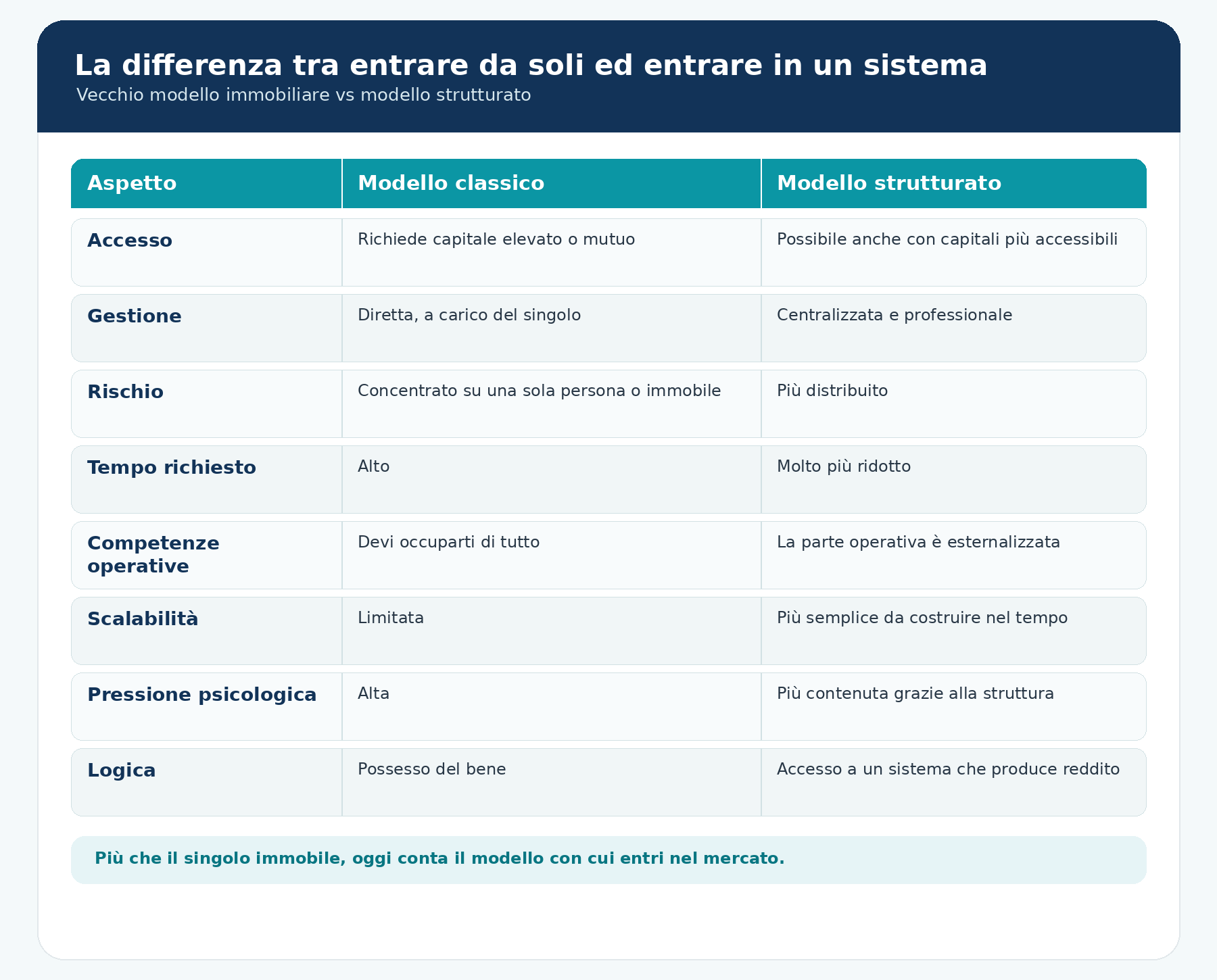
🧠 The limit of traditional models
In the traditional model:
- you buy a property
- you manage it
- you assume all the risk
In the sublease:
- you work a lot
- you have constant pressure
- you depend on monthly performance
In both cases there is a strong limit:
👉 you're alone
And this, in the long run, is the real problem.
🏗️ Evolution: a structured system
In recent years, a completely different approach has emerged.
A model where:
properties are selected strategically
they are purchased under advantageous conditions
management is centralized
and investors participate through shares
You are not buying “a house”, you are entering a structured real estate system.
💡 Where does the advantage come from?
One of the key points of this model is access.
Thanks to direct relationships with builders and operations often started in the planning phase (on paper), it is possible to obtain conditions that do not exist on the traditional market.
This allows you to:
enter at lower prices
have margins already built in
position yourself before the value goes up
And this is where the first important lever is created:
👉 the capital gain
📈 How Value Really Works
In the traditional market, the value of a property is linked to the price per square meter.
In this model, however, a different concept comes into play:
👉 the value is linked to how much that property produces
Simple example:
a property can be worth €150,000 on the market
but if it generates €30,000 per year with short-term rentals
its real value changes completely.
This opens up a new logic:
- the shares represent a part of the value produced
- whoever enters first can do so under more advantageous conditions
- the yield does not only depend on the trading, but also on the asset's ability to generate income
🚀 The advantage for those who enter the system
This model allows you to obtain multiple levers at the same time:
monthly income from short-term rentals
growth in value over time
access to structured transactions
fully outsourced management
And above all:
👉 you are not alone
👉 you don't have to manage operationally
👉 you don't depend on a single property
📊 Concrete results
Over time, this approach has led to very interesting results.
In several real cases:
Net ROI from rentals never below 10% per year
peaks up to 18% per year
capital gains, even very significant ones
In some specific situations, thanks to early entry, some investors have found themselves with:
👉 shares purchased at half their final value
👉 significant revaluations over time
This is not guaranteed… but it is a consequence of the model.
🛡️ Protection, privacy and structure
Another aspect that is often underestimated concerns the structure.
In this type of system:
the shares are separate from personal assets and cannot be seized
generational transition is easier
taxation is optimized
And this adds a level of protection that doesn't exist in the classic model.
If you want to know another model to further increase your level of security, I wrote another interesting article: GOLD: FROM ANCIENT HISTORY TO ITS IMPORTANCE IN THE MODERN WORLD
🌍 Geographic diversification (the real shield)
Another key point is diversification.
Operating on multiple international markets allows you to:
reduce the risk
balance performances
adapt to global situations
In particular contexts (such as periods of crisis or international tensions), a structured system can also redistribute results across multiple operations.
👉 It's a logic that a single investor, alone, can hardly apply with the same strength.
🎯 The real advantage
All this is not to say that “the perfect solution” exists.
Let's clarify one thing:
👉 today the real advantage is not having a property
👉 is having access to the right model
Because in the modern real estate market:
He who is alone struggles
he who improvises takes risks
whoever enters structured systems accelerates
🚀 Where to really start
If you've made it this far, you've probably already figured one thing out: it's not just about making an investment.
It's about building a system that works for you, and the first step isn't finding the “right opportunity.”.
It's about starting to move with awareness, choosing:
👉 the model
👉 the people
👉 the structure
Because that's where things really come from. long-term real estate income.

✉️ Conclusion
Generating real estate income today is no longer just a matter of capital.
It's a question of vision, access and model.
For years the market was built for the few.
Whoever had access came in. The others stayed outside.
Today the game is changing.
Not because it's become easy.
But because he got smarter.
It's no longer enough to buy a house.
It's not even enough to "try".
You need:
- understand the model
- choose the right structure
- avoid shortcuts
- build over time
Because the difference between those who create real estate income and those who remain stagnant is not luck.
It's in the decisions.
🎥 Real testimonials
Beyond the numbers, there are the people.
The project includes video testimonials from those who have:
started without experience
built income over time
seen his wealth grow
They are not promises… they are paths.
🎯 The next step
If this article has opened a new perspective for you, the next step is simple:
👉 delve deeper into how this model actually works in practice
Within the project we documented:
- real operations
- concrete results
- case studies
- direct testimonies
To allow those who truly want to understand to do so clearly.
“Theory is useful. But seeing how it actually works changes everything.”
👉 If you want to understand the structure more deeply, here is a dedicated content:
https://progettoliberta.com/real-estate-di-nuova-generazione
Thanks for being with me.
David Bottero
Co-Founder of Progetto Libertà